
Hipponax
Ancient Greek iambic poet known for vulgar wit and choliambic meter.

Frederic Moore · Public domain
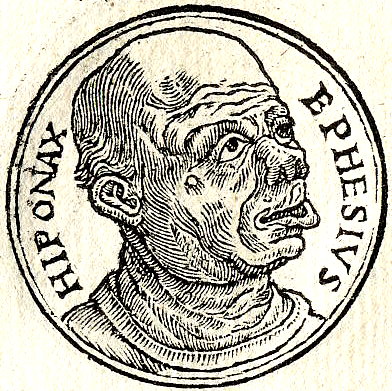
Hipponax (fl. late 6th century BCE) was an Ancient Greek iambic poet from Ephesus and later Clazomenae. He composed verses depicting the vulgar side of life in Ionian society and was celebrated by ancient authors for his malicious wit, especially for his attacks on the sculptors Bupalus and Athenis. He was reputed to be physically deformed, which might have been inspired by the nature of his poetry.
- floruit
- late 6th century BCE
- field
- Poetry
- nationality
- Ancient Greek (Ionian)
- known_for
- Iambic poetry, invention of the choliambic meter, attacks on Bupalus and Athenis
Lore & Background
Ancient authorities record only the barest details about his life, sometimes contradicting each other, and his extant poetry is too fragmentary to support autobiographical interpretation. According to the Suda, he was expelled from Ephesus by the tyrants Athenagoras and Comas, then settled in Clazomenae, and wrote verses satirizing Bupalus and Athenis because they made insulting likenesses of him. A scholiast on Horace records two differing accounts of the dispute: one that Hipponax sought to marry Bupalus's daughter but was rejected due to his ugliness, and another that Bupalus portrayed him as ugly; in both, Hipponax retaliated so savagely that Bupalus hanged himself—a story closely resembling that of Archilochus, inviting scepticism.
Reader's Guide
Hipponax composed within the iambus tradition, which in his day seems to have had the purpose of entertainment, featuring scornful abuse, a bitter tone, and sexual permissiveness. He was considered the inventor of the choliambic meter (halting iambic), which an ancient scholar described as suitable for vigorous abuse. Little of his work survives, but fragments show he employed Ionic Greek with many Anatolian and Lydian loanwords, and he avoided epic phrasing except in parody. His influence extended to Alexandrian poets such as Callimachus and Herodas, who sought alternative styles. His colorful reputation as an acerbic social critic made him a popular subject for verse, as in a choliambic epigram by Theocritus. The extant work also includes fragments of epodes, though their authorship is disputed by many modern scholars, who attribute them to Archilochus.
Did You Know?
- Hipponax was considered the inventor of the choliambic meter, which substitutes a spondee or trochee for the final iambus.
- According to a scholiast, Hipponax's verse attacks drove the sculptor Bupalus to hang himself, a story similar to that of Archilochus.
- He employed Lydian loanwords, such as addressing Zeus as 'palmys' (sultan).
- A fragment describes a sexual encounter in a malodorous privy, possibly inspiring an episode in Petronius's Satyricon.
Gallery




Frequently Asked Questions
Who is Hipponax?
Hipponax was an Ionian Greek poet active in the late 6th century BCE, originally from Ephesus and later based in Clazomenae. He is best remembered for his sharp, vulgar iambic verse that mocked the social pretensions of his community.
What is the choliambic meter and why is it linked to Hipponax?
The choliambic meter is an iambic line in which a long syllable replaces the expected short one in the final position, producing a deliberately awkward, 'lame' rhythm. Ancient grammarians credit Hipponax with inventing this variant, and it became the signature of his caustic, biting style.
Who were Bupalus and Athenis in relation to Hipponax?
Bupalus and Athenis were sculptors from Clazomenae who became the targets of Hipponax's most celebrated satirical verses. Ancient writers singled out his attacks on these two craftsmen as the prime examples of his vicious wit.
Was Hipponax really physically deformed?
Ancient tradition held that Hipponax was born with a physical deformity, a detail that likely grew out of the self-deprecating and grotesque tone of his own poetry. No contemporary evidence confirms the claim, so it is generally treated as a biographical legend shaped by his work.
Why does Hipponax matter in the history of Greek poetry?
He is among the earliest surviving practitioners of iambic satire in Greek literature, setting a precedent for poets who wielded coarse, personal invective as a literary tool. His association with the choliambic meter also gave later grammarians a concrete metrical category to discuss.
More in Classical & Medieval Poets 1-24
Elsewhere in the Classical & Medieval Poets universe
Spotted an error? Know more?
This is a living reference — every entry is fact-audited, and reader corrections feed straight into our audit queue. Suggest an edit · See this site's audit record